thermocol work


bird holding a cradle


Wednesday, July 16, 2008

Tourism in Dubai is an important part of the Dubai government's strategy to maintain the flow of foreign dollars into the emirate. Dubai's lure for tourists is based mainly on shopping, but also on its possession of other ancient and modern attractions.

Dubai is the second most populous emirate of the seven emirates of United Arab Emirates after Abu Dhabi. It is distinct from other members of the UAE in that revenues from oil account for only 3% of its gross domestic product. A majority of the emirate's revenues are from the Jebel Ali Free Zone (JAFZ) [1] and now, increasingly, from tourism.

Image:Dubai International airport interior.jpg

Dubai’s location at the cross-roads of Europe, Asia and Africa makes for easy accessibility. Most capitals and other major cities have direct flights to Dubai. More than 120 airlines operate to and from Dubai International Airport to more than 260 destinations, making it one of the worlds busiest. Dubai is also the home base of Emirates Airline, international airline of the UAE, which operates scheduled services to more than 100 destinations.


The airport is currently undergoing a major expansion with the construction of Terminal 3 and new 60 meter (197 foot) wide and longer runway. This expansion will make the airport fully Airbus A380 compatible.

The airport will also undergo an expansion to allow two stations of the Red Line of the Dubai Metro to be built within the complex. One station will be constructed in Terminal 1 and the other in Terminal 3. The Metro system is not expected to be fully operational until 2012.

Dubai's government has announced the construction of a new airport in Jebel Ali termed Dubai World Central International Airport. It is expected upon completion to be the fourth largest airport in the world by physical size, though not by passenger metrics. Construction is expected to finish by the year 2017. On completion, Dubai International Airport is expected to be able to accommodate up to 70 million passengers.

The new terminal under construction

Image:Dubai airport new terminal.jpg

Oqyana, which is also known as Oqyana-World First, is a development project being built on the man-made islands of The World, off the coast of Dubai, United Arab Emirates. Its name was taken from the the Arabic word for Oceanic and it will occupy 19 islands of The World, which correspond to the islands of Australasia (Australia and New Zealand).

Oqyana will have spectacular views of the Dubai coastline and be accessible from the mainland through a ferry service. It is expected to the residence of between 10 to 12 thousand people as it will will comprise of more than 1,650 sea-view apartments and mansions, 90 water homes, about 170 canal homes, and two high-end hotels, including a spa resort.

Oqyana will occupy a total area of 1.87 million square meters (20 million square feet) and a total onland area of 417 thousand square meters (4.5 million square feet). It will contain 17 kilometers (10.5 miles) of inter-linked walkways, 5,300 meters (17,388 feet) of shore front and a marina with over 1,500 private yacht berths. It is being developed at a cost of US$ 3.5 billion (AED 13 billion) by a division of Kuwait-based Investment Dar and was masterplanned by Australian-based Woods Bagot.

Expected Completion Date - In 2012
Managed by - OQYANA Real Estate Company
Location - The World, Dubai, United Arab Emirates

The World Islands [Dubai] Photograph

Dubai (in Arabic: دبيّ‎, transliteration: dubaīy) can either refer to an emirate (one of seven) in the United Arab Emirates (UAE) in the eastern Arabian Peninsula, or that emirate's main city, sometimes called "Dubai city" to distinguish it from the emirate.

Written accounts documenting the existence of the city have existed at least 150 years prior to the formation of the UAE. Dubai shares legal, political, military and economic functions with the other emirates within a federal framework, although each emirate has jurisdiction over some functions such as civic law enforcement and provision and upkeep of local facilities. Dubai has the largest population and is the second largest emirate by area, after Abu Dhabi.[4] Dubai and Abu Dhabi are the only two emirates to possess veto power over critical matters of national importance in the country's legislature.[5] Dubai has been ruled by the Al Maktoum dynasty since 1833. The emirates' current ruler, Mohammed bin Rashid Al Maktoum, is also the Prime Minister and Vice President of the UAE.

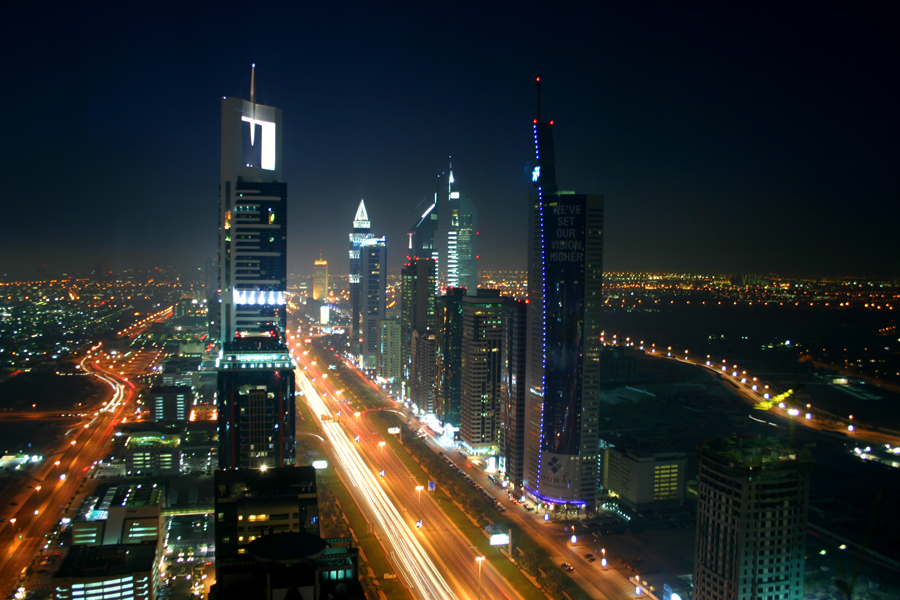
Image:Dubai night skyline.jpg

Monday, July 14, 2008

Emirates to raise ticket prices from August 1

Emirates will be increasing ticket prices across all sectors, effective August 1, owing to soaring fuel prices, said the airline. The carrier's fares would go up by 10 per cent for First and Business Class and five per cent for Economy Class. "The staggering increase in fuel prices has had an inflationary effect on all our operational costs, forcing us to revise our fares accordingly," a spokesperson told Emirates Business.
"Emirates' fares remain competitive and we will continue to work very hard to shield our customers from major price fluctuations, while delivering a high quality in-flight product and travel experience," the spokesperson added. This is the second increase in the airline's fares in the last three months. Emirates had increased prices by nine per cent in June 2008, based on an oil price of US$110. "Emirates is better positioned than most global airlines to ride out the impact of high oil prices," Emirates' President, Tim Clark, recently told Emirates Business. Despite having made a profit of US$1.5 billion (Dh5.5bn) last year, Emirates had to pay an extra US$500m for fuel than budgeted.
Fuel costs have taken up around 43 per cent of Emirates' expenditure, up from just 30.6 per cent in April. "It is well above what we had thought of," said Clark. – Emirates Business 24|7

Emirates to launch A380 with bi-coastal inauguration

Emirates Airline has announced plans to showcase the new, double-decker Airbus A380 during exclusive familiarization flights in San Francisco and Los Angeles.

The familiarisation flights will immediately follow the inaugural flight of the aircraft from Dubai to New York JFK on 1-Aug-08.

Invited guests from San Francisco and L.A. both slotted to receive their own daily non-stop service featuring the Boeing 777-200LR from Dubai this fall, will have the opportunity to view the A380 before it begins three-times weekly service from Dubai to New York. Emirates' Dubai to New York service marks the first time any carrier will operate the A380 commercially in the United States.

Emirates to launch A380 with bi-coastal inauguration


Nigel Page, Senior Vice President, Commercial Operations the Americas said, "The A380 familiarization flights will give guests from San Francisco and Los Angeles a chance to feel and experience the new aircraft as well as learn more about Emirates' world-class amenities and comforts. The events will offer an exciting introduction to the airline in advance of our launch of services from Los Angeles and San Francisco later this year."

"We are very proud to be the first airline to bring the A380 to North America as a commercial service and consider this a milestone for the aviation industry. We are also delighted to be able to offer access to the aircraft on both the east and west coasts of the United States," added Page.

Emirates' San Francisco familiarisation flight is scheduled for Monday, August 4th, 2008 out of San Francisco International Airport. Invited guests will have an opportunity to tour the aircraft which features 489 seats in a three-class configuration (14 first class, 76 business class and 399 economy class).

On 5-Aug-08, residents of Los Angeles will have their own opportunity to see the A380 at the Flight Path Museum at Imperial Terminal at LAX. Not only will invited Angelenos be privy to Emirates' award-winning on-board amenities and premier service, but they will also be flying aboard the airline industry's most fuel efficient aircraft.

Powered by American aircraft engine maker Engine Alliance's GP7200 engines, Emirates' A380s can fly up to 7,456 miles on a full load, has 13 tons of bellyhold capacity for cargo and offer better fuel economy per passenger mile than most hybrid passenger cars. The A380 is also quieter, both inside and outside of the cabin, which means more comfort for passengers.

Each familiarisation flight will last approximately two hours.

(c) Centre for Asia Pacific Aviation. Date posted: 10-Jul-08

In-depth analysis of the Middle East airline and airport sectors, including latest traffic and financial reports and outlooks, is available each month in the Monthly Essential Middle East.